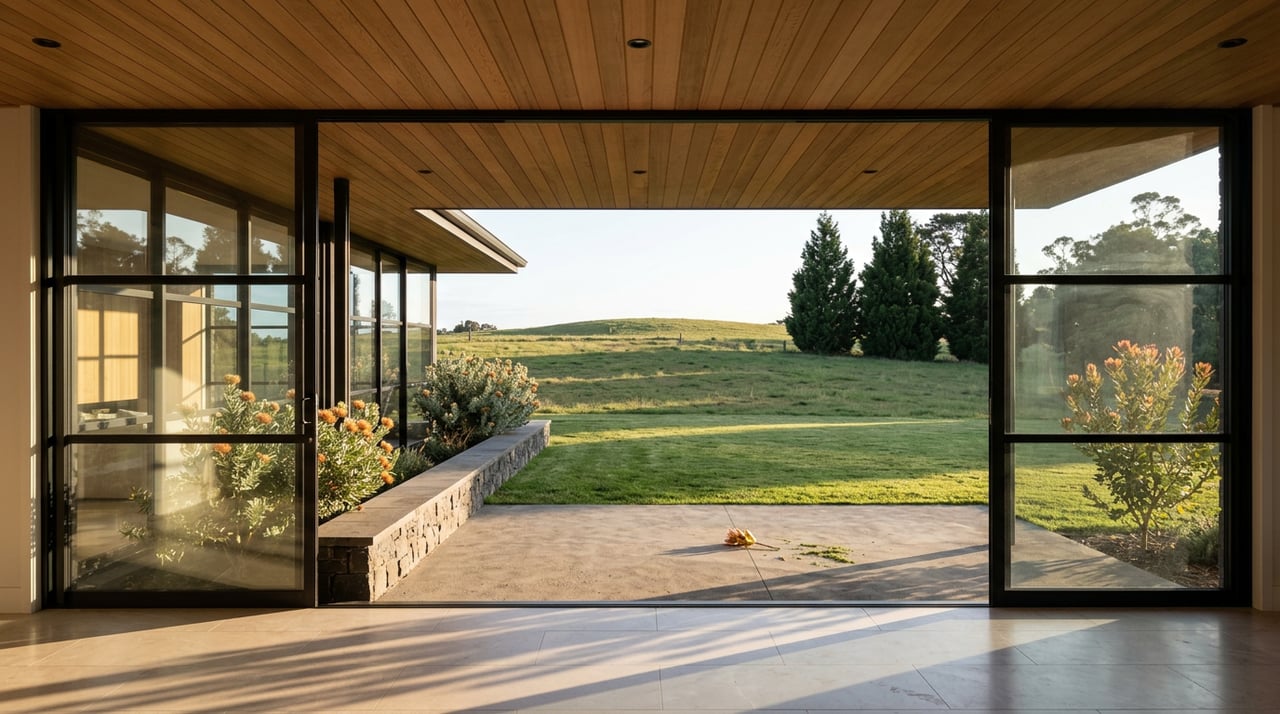
Two properties both get called "Kamuela real estate" right now, and they could not be less alike. One is a multi-acre parcel above the Kohala Coast with unobstructed ocean and mountain views, priced for a buyer who is comparing it to Mauna Lani or Mauna Kea inventory. The other is a three-bedroom home on a quarter acre near the center of Waimea town, with Mauna Kea views and quiet surroundings, that listed for $970,000 in May 2026 with 1,348 square feet to show for it. Both sit inside the same reporting area. Neither one is what the county's headline median is actually describing.
That median just moved a lot. Countywide reporting on Hawaii Island's higher-end segments showed Kamuela's median sale price climbing to $2.1 million, up 50 percent year over year. If you're comparing Big Island neighborhoods on price alone, that number looks like Waimea priced itself out of reach in a single year. It didn't. What happened is a composition shift, not a wave of appreciation, and understanding the difference is the entire reason to read past the headline before you decide Kamuela is or isn't in your range.
What Actually Jumped 50 Percent
A 50 percent year-over-year move in a median is almost never a story about every home in the area getting 50 percent more expensive. It's a story about which homes happened to close escrow during the measurement window. The reporting behind that $2.1 million figure attributed the jump to a greater concentration of higher-priced resort and luxury sales closing in Kamuela specifically, the same dynamic that pushed Waikoloa's reported median to $1.1 million, up 144 percent, in the same period. Neither number reflects a typical home. Both reflect a market where monthly transaction counts are small enough that a handful of multimillion-dollar closings can swing the average by double digits without a single ordinary listing changing price at all.
This matters for negotiation, not just curiosity. A buyer who anchors on the countywide median and assumes every Kamuela listing needs to compete with $2 million comparables will overpay for a modest in-town home, or walk away from something reasonably priced because the headline number spooked them. A seller with a smaller in-town property who assumes that same median applies to their listing risks pricing themselves out of their own, much less rarefied, buyer pool.
The Quiet Math Inside Waimea's Own Numbers
Even setting the countywide luxury-concentration effect aside, Waimea's own trailing data tells a story worth sitting with. Over the three months ending April 2026, the median sale price of a home in Waimea was $1.1 million, down 3.6 percent from the same period a year earlier. In that same window, the median price per square foot was $655, up 25.2 percent year over year. Homes also sat on the market longer, a median of 138 days compared to 120 days the year before.
Read those two numbers side by side and they don't tell a simple story. Price per square foot rose sharply. Overall price fell slightly. The only way both are true at once is if the typical home selling in that window was meaningfully smaller than the typical home that sold a year earlier. In plain terms: buyers in early 2026 were paying about the same total dollars, but for less house, than buyers a year before. Land, construction, and insurance costs are climbing faster than what most buyers can or will spend in total, so the market is compensating with smaller footprints at a similar price point rather than lower prices for the same square footage. That's a very different signal than "Waimea got cheaper," and it's the kind of detail a single median will never surface.
Three Waimeas Wearing One Zip Code
The reason a single median struggles here is that "Kamuela" covers at least three distinct submarkets, each with its own buyer pool, price logic, and infrastructure.
In-town lots cluster around subdivisions like Kamuela Meadows, where build-ready half-acre and one-acre parcels sit minutes from Waimea town, the local schools, dining, cultural venues, Parker Ranch Arena, farmers markets, and medical facilities. Land here trades in a range accessible to a first-time Big Island buyer, and existing in-town homes on the smaller end can still be found in the $400,000s, even as the same town holds estate-level properties well above $1 million.
Upcountry ranch acreage is Waimea's other identity, the working pastureland that gives the town its paniolo character. These parcels are priced by acreage and access as much as by square footage, and many sit on land with no connection to county water at all.
Then there is the resort-adjacent luxury corridor along the coast, where Kamuela's reporting boundary overlaps with the broader South Kohala market that includes Waikoloa, Mauna Kea, and Mauna Lani. That segment posted average sales prices near $1.99 million in a mid-2026 market report, up 12 percent year over year, with total sales volume up 25 percent and sales above $1 million up 17 percent. This is the segment doing the heavy lifting on Kamuela's countywide median, and it has almost nothing in common with a quarter-acre lot near the middle school.
| Submarket | What it looks like | Typical price signal | Water |
|---|---|---|---|
| In-town Waimea | Subdivisions like Kamuela Meadows, walkable to town amenities | Low-to-mid $400,000s through low $1 millions | County water |
| Upcountry ranch acreage | Working pasture, horse and cattle country, Parker Ranch adjacent | Priced by acreage and access, highly variable | Often catchment only |
| Resort-adjacent luxury corridor | Overlaps South Kohala's Waikoloa, Mauna Kea, Mauna Lani segment | Averaging near $2 million, driving the countywide median | County water, resort infrastructure |
What the Median Never Prices In
Two costs sit underneath every Waimea listing that no median captures, and both change the real math on a comparison between Kamuela and coastal Big Island neighborhoods.
The first is water. Many upcountry and rural Waimea properties rely entirely on rainwater catchment for household and, on working ranches, for livestock needs as well. The region's 40 to 60 inches of annual rainfall plus regular fog drip make catchment a genuinely reliable primary source, but Waimea's defining challenge is wind. Trade winds funnel through the Kohala Gap at 30 to 40-plus miles an hour, driving rain sideways and depositing debris on rooftops in a way that standard mainland catchment setups aren't built to handle. A system engineered for local conditions needs reinforced gutter brackets, first-flush diverters sized for heavy debris, wind-resistant tank tie-downs, and inlet screens rated for the Kohala Gap's particular weather, with a typical home running a 5,000 to 10,000-gallon tank. None of that shows up in a listing price, but it shows up in a due diligence checklist, and it's a real cost variable between an in-town home on county water and an upcountry parcel that isn't.
The second is insurance, and here Waimea actually has an advantage the median obscures in the other direction. Waimea's elevation and inland position keep it out of the direct hurricane-wind and coastal-flood exposure that drives premiums up on much of the rest of the island. Recent rate comparisons for the area put typical Waimea homeowners premiums in the range of roughly $777 to $1,067 a year, noticeably lower than what a similarly priced coastal home might carry once wind and flood coverage are added in. A buyer weighing a $1 million Waimea home against a $1 million coastal property isn't comparing equal ongoing costs, even though the sale price on paper looks the same.
A Few Questions That Come Up Often
Is Kamuela actually more expensive than it was a year ago? Parts of it, yes, and parts of it, not really. The countywide median moved because more luxury and resort-adjacent sales closed in the window being measured. Waimea's own broader trailing data showed the typical sale price down slightly, with buyers getting less square footage for the same money. Both things are true at once, which is exactly why one number can't answer the question.
Should I trust a Waimea listing price against the county median? No. Compare it against recent closings in the same submarket, in-town, upcountry, or resort corridor, not against a countywide figure that's being pulled by a handful of high-end sales.
Does every Waimea property need catchment water? No. In-town subdivisions typically connect to county water. Catchment is more common on rural and upcountry parcels, and it's worth confirming early, since it changes both the due diligence checklist and the ongoing maintenance picture.
Reading a Kamuela listing against the right comparable, not the countywide headline, is the difference between a confident offer and a guess. If you're weighing a Waimea property against something on the coast, or trying to figure out which of the three Kamuelas actually fits your budget and your plans for the land, Wai Pacific can walk through the real comparables with you and help you price with the specific submarket in mind, not the average of three very different markets. Start Your Island Real Estate Experience.
This article is general information, not legal, tax or financial advice. Consult a qualified professional about your situation.