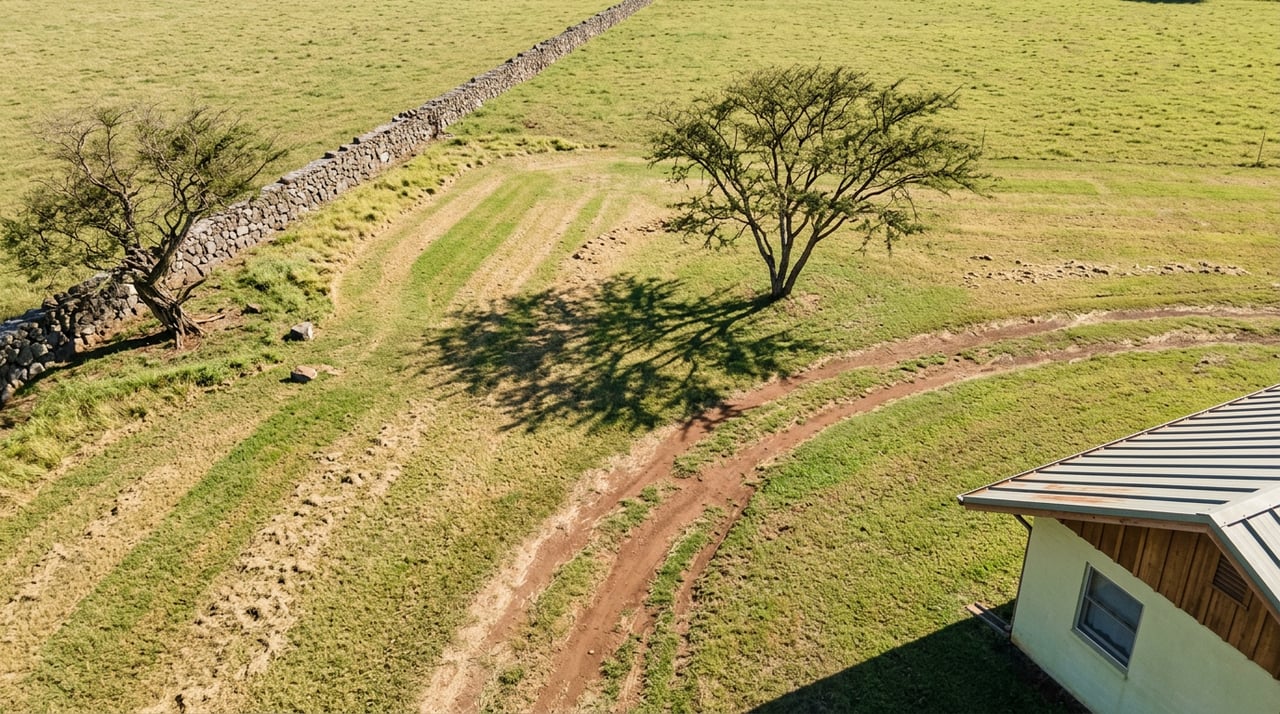
Two twenty-acre pasture parcels in Waimea's uplands can look identical on paper. Same soil, same fence line, same view north toward Mauna Kea. Yet one might carry a taxable assessed value far below market value, while the other, worth the same $480,000 on the open market, gets taxed as if it's worth the full amount. The land isn't different. The paperwork is.
That gap is the real story in Kamuela real estate right now, and it has almost nothing to do with interest rates or inventory. The Hawai'i County Code shows that Hawai'i County rewrote its agricultural tax program in 2023, and that the transition window for the old rules closes on September 1, 2026. If you own ag-zoned land in Waimea, or you're buying it, that date matters more than almost any other number attached to the property.
What the county actually got rid of
For years, Hawai'i County ran a "non-dedicated agricultural" classification that let landowners get a lower tax assessment on ag-zoned property with a fairly light application, one page, no long-term commitment. It was meant for people getting a farm started. It became something else. Testimony to the County Council described it as a program used by wealthy landowners to lower tax bills on land held mainly as open space or a view, not as a working farm, and the criticism was pointed enough that the Council voted in 2023 to sunset it entirely.
In its place, the county created three replacement tracks: a three-year dedicated agricultural program, a ten-year dedicated program that offers a deeper discount in exchange for the longer commitment, and a Community Food Sustainability Program aimed at smaller-scale or diversified growers on the island's east side. Waimea's ag corridor runs from working cattle ranches to newer large-lot communities like Waikiʻi Ranch, where forty-acre parcels sit zoned agricultural on the slopes toward Mauna Kea, and any of them could fall under the old classification. Anyone still parked in the non-dedicated program has to move into one of the three replacement tracks or lose the benefit, and this year's filing deadline for that move is September 1. Miss it, and the non-dedicated track keeps winding down anyway, since the county has said it will be gone entirely.
Zoning alone was never enough to get the tax break, and buyers who assume "it's zoned ag, so the tax rate is low" are working from an outdated picture of how this works.
Growing your own food doesn't count anymore
The county has been direct about what qualifies. A backyard garden and a few laying hens for your own table do not, even on land that's zoned for exactly that use. A Hawai'i County Council member put it plainly in comments reported by Honolulu Civil Beat: "It is not for self-use." The Community Food Sustainability Program, the most accessible of the three new tracks, still requires documented proof that the owner sold or donated at least $1,000 worth of food in a year, along with paperwork showing intent.
That distinction has real teeth for anyone buying land in Waimea with a loose plan to "do a little farming." If the use doesn't rise to what the county now recognizes as agriculture, in writing, the parcel gets taxed like any other residential lot, not like the ranch next door with an active lease.
The leverage in these programs isn't really in the tax rate itself; the real swing sits in what gets multiplied by that rate. Instead of market value, dedicated ag land is assessed using fixed per-acre figures listed in the County of Hawai'i's agricultural assessment values, somewhere between $14 and $420 an acre for pasture depending on quality, and $1,500 to $3,000 an acre for a crop like coffee, as the County's Agricultural Use Guidelines show. That substitution, market value swapped for a fixed use value, can leave a parcel with a taxable assessed value well below its market value under the three-year program. Same acreage. Same fence line. A different number sitting in the county's file.
The tax bill that shows up after the sale closes
If you're under contract on land that's zoned agricultural but isn't currently dedicated, that isn't necessarily a dealbreaker. A lapse in an active dedication can mean a rollback tax. That's not a line item most buyers think to ask about during due diligence, and it's exactly the kind of thing that surfaces during a title search or a post-closing county notice rather than during a walkthrough.
If you're buying ranch or pasture land in Kamuela this year, ask for the seller's most recent property tax bill and their current dedication application, not just a general statement that the land "gets the ag rate." If you're selling, check your own filing status before you list. A dedication that's about to lapse, or one that was never properly renewed under the new three-track system, can turn into a surprise for whoever owns the parcel when the county catches up to it.
Ag zoning doesn't mean rental income
Buyers sometimes assume that ag-zoned acreage with a guest cottage or an extra structure is an easy short-term rental play. It isn't, and the tax dedication has nothing to do with it. Hawai'i's state land use law generally prohibits short-term vacation rentals on property in the agricultural district, and county zoning, as set out in the Hawai'i County Code, sits on top of that restriction rather than overriding it. A parcel can be perfectly qualified for a ten-year ag dedication and still be entirely off-limits for a nightly rental listing. For anyone weighing whether a Kamuela property could also generate short-term rental income, our guide to Hawai'i County's short-term rental rules walks through what's actually permitted by zone.
The other paperwork upcountry land carries
Much of the Waimea and Kohala uplands has no county water line to tie into at all. Properties run on a private well or a rainwater catchment system instead, and catchment water still needs a dedicated pump to build any pressure at the tap. That means solar and battery sizing on an off-grid property has to account for that pump running reliably, not just lights and a refrigerator. It's a separate line of due diligence from the tax filing, but it often sits on the same parcel, and buyers who focus only on the ag dedication and skip the water question end up managing two surprises instead of pricing in one.
What this means if you're buying or selling in Kamuela right now
The price on a Kamuela land listing has never told the whole story, but this year the gap between what a parcel is worth and what it's taxed as is wider and more consequential than usual. A seller with a lapsed or unfiled dedication is sitting on a tax liability that could reshape a buyer's carrying costs, or trigger a rollback bill neither party expected. A buyer chasing the ag rate on a parcel with no documented farming plan is buying a discount that may not survive the county's first review.
None of this shows up in a listing photo. It shows up in a filing date.
A few questions that come up often
I grow food for my own family on my land. Doesn't that count as agricultural use? Under the current programs, no. County officials have been explicit that personal or subsistence use doesn't meet the bar. The programs are built around documented commercial activity, whether that's a lease to a rancher, a farm plan for a crop, or proof of food sold or donated for the Community Food Sustainability track.
What actually happens if a dedication lapses partway through the commitment period? The county can assess a rollback tax. That's a liability worth checking before you buy, and worth avoiding before you sell.
If you're weighing a ranch parcel in Waimea, or trying to figure out what your own upcountry land is actually worth once the paperwork catches up with it, Wai Pacific works this market from the ground up, from the fence line to the filing deadline. Start Your Island Real Estate Experience and let's look at what your land's status really is before you list it or make an offer on someone else's.
This article is general information, not legal, tax or financial advice. Consult a qualified professional about your situation.